 Inbox Spy
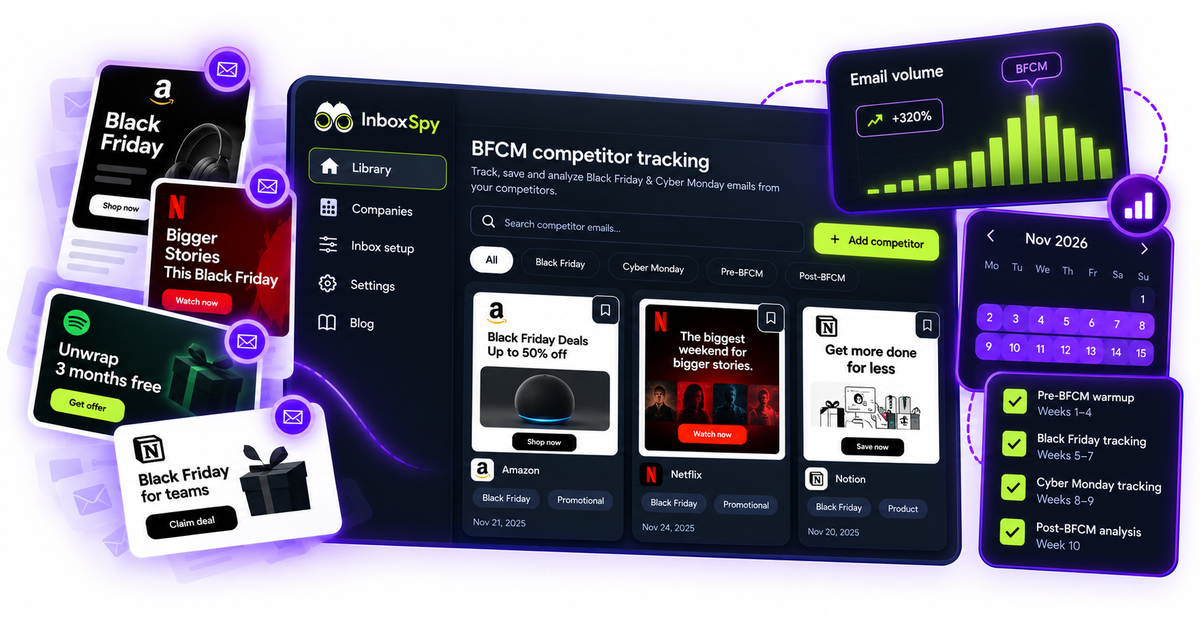
Why start Black Friday competitor email tracking now?
Black Friday falls on November 27 in 2026, followed by Cyber Monday on November 30. But a useful competitor study does not begin when the sale announcement lands. By then, you have missed the quieter decisions that shaped the campaign: list-building pushes, preference surveys, gift-guide education, early-access invitations, loyalty messaging, and the first changes in send frequency.
Starting roughly ten weeks before Black Friday gives your team a baseline. You can see what each company sends during an ordinary week, then recognize when its holiday strategy begins. That difference is often more informative than the final discount. A competitor that moves from two emails per week to daily sends is making a cadence decision. A brand that starts promoting bundles in October is revealing its preferred offer architecture. A company that asks subscribers to choose categories is preparing segmentation before the peak.
The goal is not to predict every promotion or copy another brand. It is to watch the market develop in real time and preserve enough evidence to make your own campaign choices with confidence.
Set up the research before the countdown
Choose five to ten companies that can teach you something useful. Include direct competitors, one or two category leaders, and a few brands known for strong retention or ecommerce execution. A focused set produces cleaner comparisons than a list of fifty companies nobody has time to review.
Create a separate tracking address for each company and record the signup path. Subscribe through public forms you are authorized to use: newsletters, loyalty programs, sale alerts, lead magnets, free trials, or abandoned-cart flows where appropriate. If one company has several meaningful entry points, use a separate address for each path so you can tell which sequence produced each message.
Before the first review, agree on a small set of questions. When does each brand first mention the holiday? Does it use early access? How does the offer change? Which products receive attention? How quickly does urgency escalate? What happens after a subscriber clicks but does not buy? Those questions keep the project connected to real campaign decisions.
The 10-week BFCM competitor monitoring plan
Use the countdown as a weekly research rhythm. Capture everything automatically, but review the archive once a week. During Black Friday week, switch to a daily review so rapid changes in offers and cadence do not blur together.
Do not treat the schedule as a prediction that every brand will follow. Its purpose is to give the team a consistent lens. If a competitor stays quiet until the final week, that absence is still a useful finding. If another launches in October, the archive shows exactly how its long campaign develops.
What to track in every competitor Black Friday email
The subject line is only one layer of the campaign. Save the complete email and attach enough context to compare messages later. At minimum, track these fields:
- Company, sender name, sender address, and signup source
- Received date, time, day of week, and sequence position
- Subject line, preheader, headline, and primary call to action
- Offer type, discount depth, minimum spend, exclusions, and deadline
- Featured products, bundles, gifts, shipping promises, and payment options
- Audience cues such as VIP, new customer, returning customer, or loyalty member
- Urgency devices including countdowns, scarcity, stock language, and final-hour framing
- Creative pattern, image-to-copy balance, mobile layout, and seasonal branding
- Landing-page destination and whether the on-site offer matches the email
Keep the observations factual. Write "40% off selected products until midnight" rather than "strong offer." Concrete notes remain useful after the campaign, when the original excitement and inbox pressure are gone.
A simple Black Friday competitor scorecard
A scorecard helps a team compare strategy without pretending every creative decision can be reduced to a number. Rate each competitor from one to five on the dimensions below, then add a short evidence note and a link to the email that supports the rating.
The evidence note is more important than the score. "VIP access opened 24 hours early with a separate landing page" gives the team something it can discuss. A four without supporting detail does not.
Turn competitor evidence into campaign decisions
Hold a short review at four weeks out, two weeks out, and immediately after Cyber Monday. Bring selected emails into the meeting instead of relying on memory. For each pattern, decide whether it represents a category expectation, an overused convention, or an opportunity to take a different approach.
If nearly every competitor leads with the same discount language, your campaign may need stronger product framing or a clearer reason to choose your brand. If competitors begin early but repeat the same creative for weeks, you may plan more variety. If landing pages hide important conditions that emails promise, transparent terms may become a useful trust signal.
Translate findings into a decision log with four columns: observation, evidence, implication, and action. For example, the observation might be that three competitors reserve their deepest discount for existing customers. The evidence links to those messages. The implication is that loyalty is being protected rather than treated as an afterthought. The action could be to define your VIP offer and access window before the public campaign.
Competitor research should sharpen judgment, not replace it. Your inventory, margins, customer expectations, and brand position still determine the right campaign. The archive simply makes the market context visible.
Common BFCM monitoring mistakes
Starting when the main sale begins
This captures the loudest part of the campaign but misses list growth, segmentation, early education, and offer preparation. Start early enough to understand the baseline.
Saving screenshots without context
A visual can be useful, but it may omit the sender, timestamp, preheader, signup source, and destination. Preserve the complete message and its metadata whenever possible.
Tracking discounts but ignoring sequence
A 30% offer can play very different roles as an early-access reward, a public launch, or a final extension. Evaluate where the message appears in the sequence.
Collecting more than the team can review
A smaller, well-labeled archive is more useful than hundreds of unclassified emails. Focus on competitors connected to decisions you expect to make this season.
Copying the most visible campaign
You cannot see a competitor's margins, segments, conversion rate, or inventory pressure from the email alone. Treat every message as evidence of a choice, not proof that the choice worked.
What to review after Black Friday and Cyber Monday
Do not close the research project on Monday night. Continue tracking for at least two weeks. Post-sale messages reveal how brands handle extensions, shipping cutoffs, gift positioning, returns, loyalty follow-up, replenishment, and the transition into the rest of the holiday season.
At the final review, build a one-page summary for each competitor: first holiday mention, first confirmed offer, peak send day, deepest discount, strongest differentiator, most repeated creative, Cyber Monday change, and post-sale follow-up. Add links to the messages that support each point.
Then preserve the 2026 archive as a baseline for next year. A durable campaign record lets the team compare how offers, timing, and positioning evolve instead of starting from zero every autumn. For a broader foundation, use the competitor email monitoring guide and the lifecycle email analysis framework.
Start your BFCM competitor email archive
Create a private Inbox Spy workspace, add the brands you want to follow, and collect each campaign through a company-specific tracking address.
Create free workspace